Artemis II Mission: Happy April Fools' Day
Space’s “Fools’ Day”
On April 1st, 2026, while the world exchanged jokes and fake news, NASA launched its most ambitious mission in half a century: Artemis II. The fact that the chosen date was April Fools’ Day is not a statistical coincidence; the Archive classifies it as a “Revelation of the Method” (see Case 001). Those who pull the strings enjoy telling the truth through a joke that no one wants to believe.
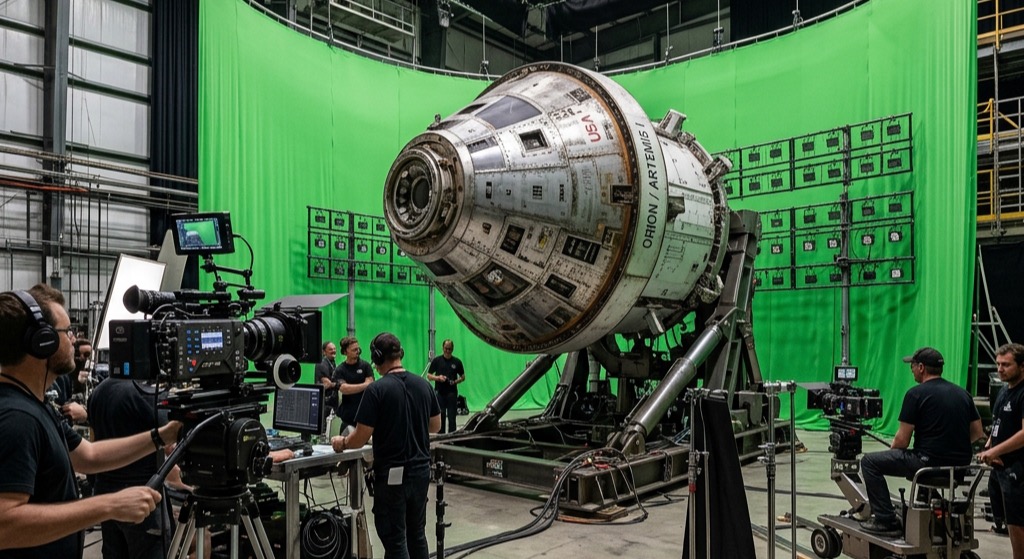
The Orion capsule, the centerpiece of the mission, completed a 10-day journey around the Moon, returning yesterday with ultra-high-definition images. But what no one in the mainstream media asks is: Why, 56 years later, are we still limiting ourselves to watching from afar?
The Digital Audit Paradox
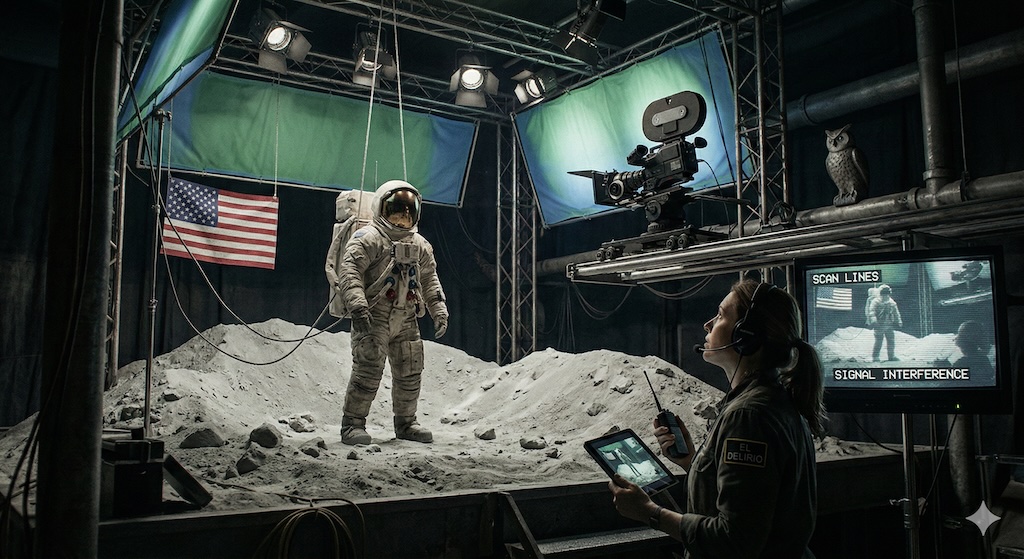
In the 1960s, faking a moon landing was relatively simple thanks to low resolution. Film grain, fuzzy shadows, and a lack of detail allowed wires and stagehands to be hidden (see Case 003 and Case 004).
Today, technology has become the enemy of simulation. Producing a video of an astronaut walking on the lunar surface in 8K and 120fps is suicide for any CGI department:
- Dust Physics: Simulating the behavior of regolith in reduced gravity without it looking like a video game animation is extremely expensive.
- Critical Light: In a vacuum, light is harsh and unforgiving. Any “set” light source would generate reflections that millions of “internet detectives” would identify in seconds.
- The Panic of the Close-Up: In an orbital flyby, 90% of the shots are recorded from inside the capsule. It’s a controlled, small, and safe set. Going outside, under the scrutiny of modern optics, is a risk NASA cannot afford.
Glitches in the Matrix
The Artemis II mission has not been free of the classic technical “slips” that fuel the Archive:
- The Plush Toy Glitch: During a live broadcast on April 4th, a plush toy floating in the cabin showed fragments of text and code floating “inside” its own texture. A failure in the rendering engine or the augmented reality mask used to simulate the environment.
- AI Halos: In the high-resolution photos of the far side of the Moon, “interpolation halos” typical of generative networks (like the Stable Diffusion method) have been found. When an AI tries to “fill in” areas with little lighting information, it generates repetitive patterns that optical physics would never produce.
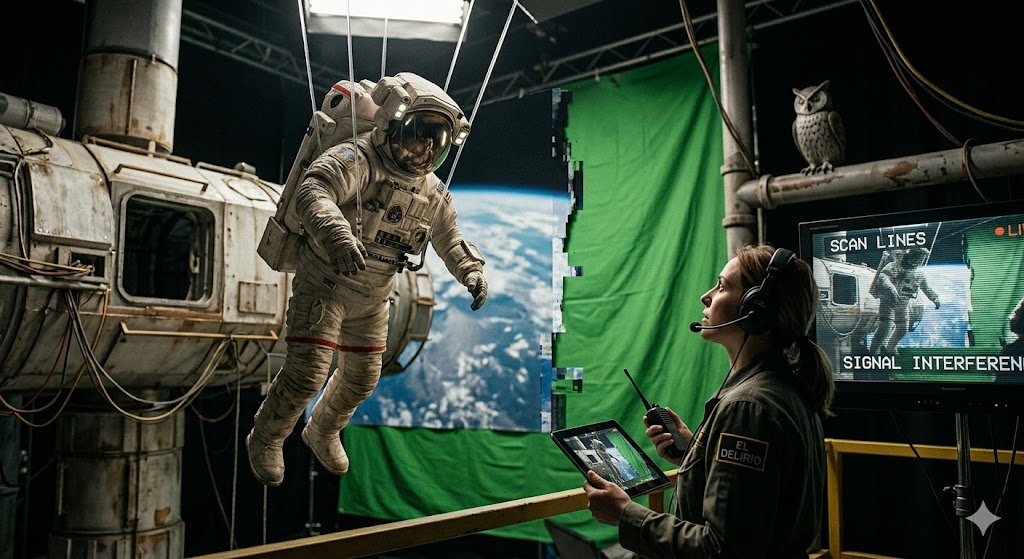
- Dropped Frame Shadows: In some shots of Earth, the planet’s curve appeared with a polygonal deformation during a single frame. A clear sign of a digital projection onto a studio window.
- The Latency Paradox: During the “live” broadcast from lunar orbit, the signal delay was barely 0.8 seconds. Considering that the speed of light dictates a minimum delay of 1.3 seconds for the Earth-Moon distance, the conclusion is physical: the signal did not come from space, but from a local server.
Error in the Script: Christina Koch’s Double Identity
As if it were a glitch in the reality rendering engine, the casting of Artemis II has left us clues that the Archive cannot ignore. Among the crew, Christina Koch stands out—holder of space records and of a “curious” namesake in acting talent databases (with credits in classical theater).
- The Engineer Archetype: Her resemblance to characters like Kaylee Frye (Firefly) is an exercise in Negative Priming. The system trains us to accept specific profiles as a guarantee of truth.
Why Do We Not Alight?
There is no “lost” technology to recover here. There is only a budget for a better TV set. The mission has returned home, but the truth continues to orbit a satellite closed due to lack of RAM in the supercomputer of the global lie.
The official version speaks of “safety”. The Archive’s reality is that it is still not possible to do it without the wires being noticed.
[ END OF TRANSMISSION ]