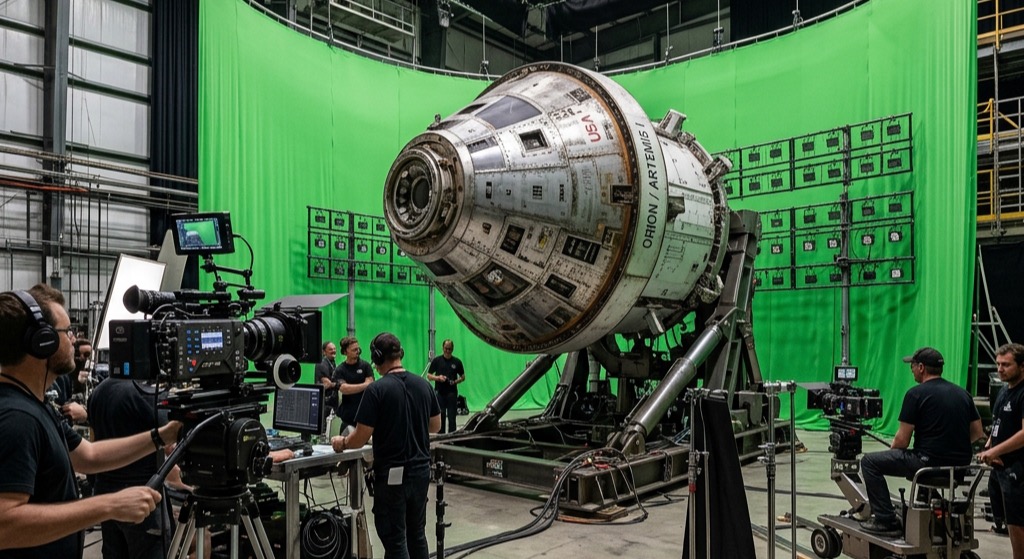
The Great Apollo Theater: The Moon Hoax
The Context: A Desperate Race
In the 1960s, the United States was losing the Space Race against the Soviet Union. The political and media pressure to reach the Moon before 1970 was immense. According to the defenders of this theory, the space agency, realizing that the technology of the time did not guarantee a safe manned round trip, opted for a “Plan B” so as not to lose the propaganda war.
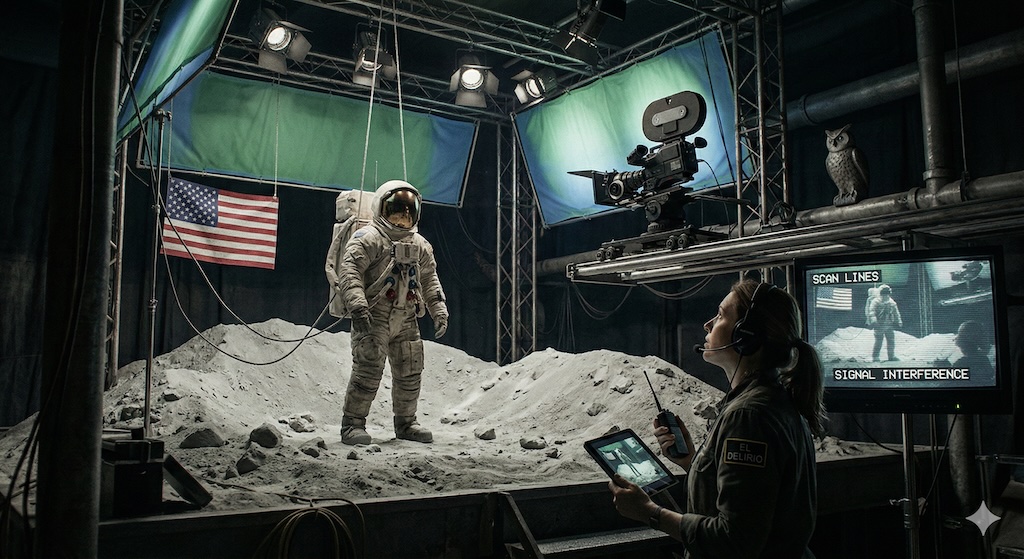
“If you can’t build a rocket that reaches the Moon, build a television set that makes you believe you reached it.”
The Visual Anomalies
For decades, independent analysts have examined the official photographs and videos of the Apollo missions, pointing out what they consider editing errors and continuity flaws in a closed-door production:
- Diverging Shadows: On the lunar surface, with a single strong source of light (the Sun), the shadows of objects should be perfectly parallel. However, multiple photos show shadows crossing at different angles, suggesting the use of artificial studio spotlights.
- The Starless Sky: Despite being in space and not having an atmosphere to blur the light, none of the official photographs of the moon landing show stars against the dark background.
- The Waving Flag: The historic videos show the American flag moving and wrinkling as if there were a breeze, a physically impossible phenomenon in the vacuum of space where there is no air.
The Invisible Barrier
Beyond the photographic details, the main technical obstacle pointed out is the Van Allen Radiation Belts. These zones of high magnetic radiation surround the Earth and protect the planet, but they are lethal to human life. Researchers of this theory argue that the Apollo capsule, built primarily of thin layers of aluminum, did not offer the thick lead shielding necessary to survive the crossing without suffering severe radiation poisoning.
The “Lost Technology”
Today, the mobile phone from which you read this has more computing power than all of NASA in 1969. So, with 21st-century technology, why haven’t we set foot on the Moon in more than 50 years? Why does the modern space program continually suffer delays due to leaks and cancel manned missions?
The official answer is an absolute jewel of involuntary comedy. In the words of NASA astronaut Donald Pettit himself:
“I’d go to the Moon in a nanosecond. The problem is we don’t have the technology to do that anymore. We used to have it, but we destroyed that technology and it’s a painful process to build it back again.”
Read it again. Humanity achieved the most spectacular engineering feat in history using computers that ran on primitive codes, and then, somehow… they “destroyed” the technology. It turns out that losing the blueprints for the Saturn V rocket and the lunar landers is just as easy as losing your house keys.
Added to this is the official admission in 2006 that the original, high-quality telemetry and video tapes of Apollo 11 had been “lost.” NASA’s excuse? They accidentally erased them to save money by reusing the magnetic reels. How convenient, right?
The moon landing became the most-watched live television event in history. A globally shared illusion that changed the balance of power on Earth, without the need, according to this theory, to ever leave it.
[ END OF TRANSMISSION ]